

Shogakukan Inc., one of Japan’s leading publishers, has launched NOVELOUS, a new light novel app designed for North American readers.
The goal is simple: bring both hit titles and hidden gems—stories that have never been translated—to fans around the world.
But for many readers, the idea of AI-assisted translation raises concerns:
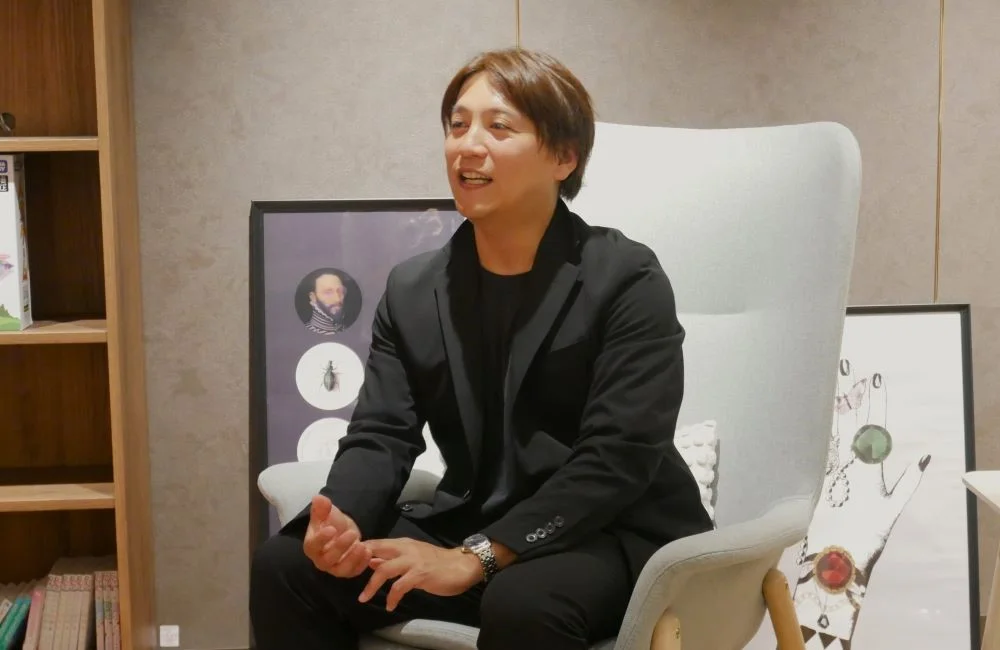
To understand what NOVELOUS actually does, we spoke with Mr. Yuki Wada, Producer in Shogakukan’s Universal Media Business Division and the person overseeing the entire project.
What became clear is this: AI is only one part of a much larger, deeply human-driven process—a productivity tool that supports translators, not a system that replaces them.
Wada’s passion for creators, his commitment to expanding opportunities for authors, and his belief in the global potential of light novels all shine through.

Shogakukan Inc.
Universal Media Business Division Producer / XR Business Promotion Office Director
Joined Shogakukan in 2001, worked in the CoroCoro Comic Editorial Department and Weekly Shonen Sunday Editorial Department, then became Editor-in-Chief of MangaONE. Currently, as Producer of the Universal Media Business Division and Director of the XR Business Promotion Office, he is involved in promoting new businesses such as NOVELOUS.
—— Q: First, could you tell us why Shogakukan decided to launch NOVELOUS in North America?

Traditionally, Shogakukan’s international publishing depended on overseas publishers reaching out to license specific titles. But they can only read so many books, so they tend to choose what’s already successful in Japan.
The challenge is that light novels often have modest print runs, and many brilliant titles never get noticed abroad simply because they aren’t obvious hits. Without licensing offers, no English editions are created—even when fantastic stories exist.
I’ve always felt that was a huge loss.
—— Q: Fans overseas often talk about amazing novels they wish they could read, but that never receive translations, right?
Exactly. Profitability is of course a factor, but to me, the greater concern is that these works simply vanish without ever being discovered.
If a translation exists, even a Hollywood creator might discover it and think, “This could make a great film.” If the story remains only in Japanese, that opportunity never appears.
By collaborating with Mantra Inc.’s diverse translation team and using their technology as a foundation, we can now translate and publish globally in-house, even for titles that overseas publishers haven’t approached.
I had tested this system before as part of anti-piracy efforts when I worked on MangaONE, and I felt it could be adapted well for novels too.
—— Q: This project isn’t just about translating e-books. Why release it as an app?
Because I want to create a community, not just a distribution platform.
With MangaONE, we made reading feel like a live event. Every midnight on release days, readers would come together at the same moment, react to new chapters, and watch comments appear in real time. That sense of shared excitement is incredibly powerful.
The content doesn’t change depending on when you read it—but the experience does. When someone across the world laughs or cries at the same line you did, that connection—the feeling of “we’re reading this together”—is something only a live ecosystem can offer.
—— Q: So you want to bring that ‘live manga’ feeling to light novels on a global scale?
Exactly. The light novel market in North America is still growing, so it’s even more important for fans to feel they’re part of a larger international community. An app allows that—real-time reactions, shared reading windows, and a space where readers can gather.
—— Q: Readers in North America may wonder: if AI is involved, does it flatten character voices or personalities?

That’s exactly the misconception I want to address.
When people hear “AI translation,” they tend to imagine a system that translates the entire book automatically, without human involvement. That’s not what we do.
—— Q: So the idea that ‘the AI does everything’ is inaccurate?
Completely inaccurate.
Even with advanced tools, the process is filled with human expertise:
The AI’s output depends entirely on the instructions it’s given. If you provide poor instructions, you get poor results.
Designing those instructions requires an understanding of story, personality, nuance, and language culture—all human skills.
—— Q: In Japanese, characters often express personality through pronouns and verbal tone. How do you preserve that in English?
Japanese has many first-person pronouns—boku, watashi, ore, and so on—and unique sentence endings that immediately signal who is speaking. In English, everyone simply says “I,” so much of that nuance disappears unless you add extra wording.
That’s where NOVELOUS’s UI becomes a powerful tool.
—— Q: Because the UI displays who is speaking?
Exactly.
In NOVELOUS, dialogue appears in speech bubbles with character icons, names, and bios. Readers can tap a character to quickly understand their personality.

Because of this design:
It lets us stay true to the author’s intent without distorting the text.
—— Q: How do you prepare the text for translation so the AI understands who is speaking?
First, our Japanese staff manually analyzes the entire novel. They assign each line of dialogue to the correct character and break down the story so that the engine has accurate structural data.
If the data isn’t linked correctly, even the best technology won’t produce meaningful output.
We also prepare detailed notes:
All of this is human-generated. Without it, no tool—AI or otherwise—can maintain character identity.
—— Q: So you can even convey nuances like “boku” vs. “watashi”?
Yes. Our translation team decides how each character would speak in natural English—slang, politeness, tone—based on the original text.
And importantly, our translators are free to rewrite lines from scratch if that produces a truer, more character-accurate result. This is a creative adaptation process, not mechanical substitution.
—— Q: Some fear that AI will take work away from human translators. How do you view that concern?
AI in our workflow is an assistant—nothing more. It helps streamline parts of the process, allowing our translators to devote more time to the creative, cultural, and stylistic elements of localization.
Human hands are always the ones crafting entertainment.
Even as technology advances, we still need:
In fact, as our workflow becomes more efficient, the demand for skilled human translators increases.
We’re not using AI to replace authors or translators. We’re using it to expand the reach of their work and open new creative possibilities.
Technology won’t disappear—it evolves. Our responsibility is to use it correctly, respectfully, and in a way that amplifies human talent.
At NOVELOUS, we hold deep respect for the translators, authors, and creators who bring these worlds to life. We want to share that passion with readers in North America, and we believe this hybrid, human-centered approach is the best way to do it.